Hey everyone! Good news! I have finally succumbed to my husband's insistence that I Tweet. Yes, I finally have a Twitter account. It is now on this blog. Although many tweets will be about cinematic moments, you will also see postings on all sorts of combinations of anatomical, pathological, artistic, and comic/graphic novel novelties.
The other news is that I will be taking a bit of a hiatus from extended blogging here while working on a project that will take up much of my time. I'm not going to tell you what it is exactly, but I'm sure you'll be shocked when you read that it is about pathology!
Friday, July 27, 2012


Thursday, June 28, 2012
LOCKOUT - Bacteria
PRISONERS IN SPACE!
My cartoonist husband and I saw Lockout --- what a blast! I don't like prison movies as a rule, but I'm going to have to make an exception for prison movies in space from now on! Sure, there were some plot and script problems, but the film was delightfully bombastic and cliched in some witty ways.
There were two extra-entertaining moments in the film. The first, see below, caused me to research wound first aid. I'll talk about that in a moment. The second was when the heroine of the film had to get a needle stuck through her eye in order to inject her brain with something, I forget what. I'm not going into details here, but it was soooo funny! Diet Coke almost came out of my nose, I was laughing so hard!

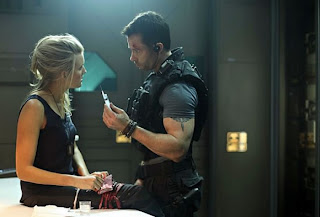
Our heroine, Emilie Warnock (Maggie Grace) has been shot in the thigh. She's got a big ol' gooey wound (thanks to make-up or special effects or whoever is in charge of wound guck!) A prison worker in a lab coat gives her first aid and dresses Emilie's wound through her pants.
For some reason I was distracted for the rest of the film by the fact that no one cut or tore Emilie's pant leg away from her wound. She has this gun shot wound to the thigh that is oozing but not spurting, as far as I can tell. My instinct is to assume it would be better to tear the fabric away from the wound site, look to make sure there aren't bone fragments sticking out of the area, and then apply a compress. Although I watch EMTs on TV, I am not one. In the moment I wanted the drama of the torn pant leg and I was distracted by the fantasy of a potential compound fracture. But trying to stop bleeding first does seem like best practice, in retrospect.
ABSORBENT AND CLEAN
The last time I was helping someone with a wound while waiting for the EMTs, I pulled a maxi pad out of my purse to use for compression and bleeding control. It was the cleanest, most absorbent thing around. Highly effective. Slightly embarrassing. I now keep an extra pad in my bag, just in case I encounter another head wound (Too much information?)

Admittedly if you are surrounded by lecherous male (presumably heterosexual) escaped prison convicts you may want to compress the area without baring any female thigh. I bet if someone had slapped a Stay-Free on Emilie's thigh, the sight of feminine hygiene products might have tempered the sexually charged mood.
Let's say keeping that pant leg on was the best strategy for immediate wound treatment in the field. Once Emilie and her rescuer, Snow (Guy Pearce), got to a prison medical facility, I thought our ex-CIA operative would bare that leg and do some cleaning or some wound assessment while he's busy flirting with Emilie. Did I mention she happens to be the president's daughter?

Is the president's daughter going to die of sepsis if her wound isn't cleaned properly within an 8 hour period(1)? No, she's not, but this gives me an excuse to blog about infection, sepsis, and necrosis.
WHAT IS SEPSIS?
Glad you asked! It's the presence of harmful bacteria in a wound or the blood stream. An overwhelming number of bacteria in tissues can lead to necrosis (tissue death) caused by toxins excreted by the bacteria, or the cell walls of the bacteria can be toxic in themselves. Infection and necrosis are often accompanied by pus(2). A lot of bacteria can lead to huge amounts of pus, or even worse, gangrene, and/or the bacteria may leave the wound site, get into the person's blood stream, and kill the person(3). Another name for bacteria in the blood is bacteremia.

1. I say eight hours because it's a plot point.
2. Pus - a thickened soup of dead tissue, white blood cells, and cellular debris. It comes in shades of whitish, yellowish, and greenish. Sometimes you can smell it! Ick. I've grossed myself out.
3. For an excellent description of infected wound signs and symptoms and their treatment check out the article on Worldwidewounds.com. Another good first aid description is at HealthGuidance.org.http://www.healthguidance.org
My cartoonist husband and I saw Lockout --- what a blast! I don't like prison movies as a rule, but I'm going to have to make an exception for prison movies in space from now on! Sure, there were some plot and script problems, but the film was delightfully bombastic and cliched in some witty ways.
There were two extra-entertaining moments in the film. The first, see below, caused me to research wound first aid. I'll talk about that in a moment. The second was when the heroine of the film had to get a needle stuck through her eye in order to inject her brain with something, I forget what. I'm not going into details here, but it was soooo funny! Diet Coke almost came out of my nose, I was laughing so hard!

This moment was worth the price of admission!
PRIORITIES Our heroine, Emilie Warnock (Maggie Grace) has been shot in the thigh. She's got a big ol' gooey wound (thanks to make-up or special effects or whoever is in charge of wound guck!) A prison worker in a lab coat gives her first aid and dresses Emilie's wound through her pants.
For some reason I was distracted for the rest of the film by the fact that no one cut or tore Emilie's pant leg away from her wound. She has this gun shot wound to the thigh that is oozing but not spurting, as far as I can tell. My instinct is to assume it would be better to tear the fabric away from the wound site, look to make sure there aren't bone fragments sticking out of the area, and then apply a compress. Although I watch EMTs on TV, I am not one. In the moment I wanted the drama of the torn pant leg and I was distracted by the fantasy of a potential compound fracture. But trying to stop bleeding first does seem like best practice, in retrospect.
ABSORBENT AND CLEAN
The last time I was helping someone with a wound while waiting for the EMTs, I pulled a maxi pad out of my purse to use for compression and bleeding control. It was the cleanest, most absorbent thing around. Highly effective. Slightly embarrassing. I now keep an extra pad in my bag, just in case I encounter another head wound (Too much information?)

Look! It's got "leak lock" protection. That'll come in handy in a gun fight.
KEEP YOUR PANTS ONAdmittedly if you are surrounded by lecherous male (presumably heterosexual) escaped prison convicts you may want to compress the area without baring any female thigh. I bet if someone had slapped a Stay-Free on Emilie's thigh, the sight of feminine hygiene products might have tempered the sexually charged mood.
Let's say keeping that pant leg on was the best strategy for immediate wound treatment in the field. Once Emilie and her rescuer, Snow (Guy Pearce), got to a prison medical facility, I thought our ex-CIA operative would bare that leg and do some cleaning or some wound assessment while he's busy flirting with Emilie. Did I mention she happens to be the president's daughter?

The dressing sort of looks like a maxi pad, doesn't it?
Later I realized that of course Snow is going to keep Emilie's pants on! He's got to get her out of there! if he disrupts the pants which are smashed into the wound by the bullet and then by the dressing, he might rip a clot off and start her bleeding again. Plus there's not really time to meticulously clean the thigh. That would be a bad idea. Better to leave the wound cleaning to a doctor.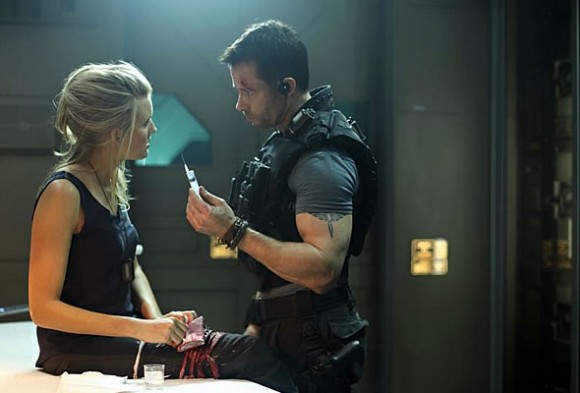
Somebody's using the excuse of lifting that tiny syringe
to show off his biceps to the President's daughter!
DOES IT MATTER?Is the president's daughter going to die of sepsis if her wound isn't cleaned properly within an 8 hour period(1)? No, she's not, but this gives me an excuse to blog about infection, sepsis, and necrosis.
WHAT IS SEPSIS?
Glad you asked! It's the presence of harmful bacteria in a wound or the blood stream. An overwhelming number of bacteria in tissues can lead to necrosis (tissue death) caused by toxins excreted by the bacteria, or the cell walls of the bacteria can be toxic in themselves. Infection and necrosis are often accompanied by pus(2). A lot of bacteria can lead to huge amounts of pus, or even worse, gangrene, and/or the bacteria may leave the wound site, get into the person's blood stream, and kill the person(3). Another name for bacteria in the blood is bacteremia.

Bacteria come in many shapes and sizes...
Yes, even the pants of the President's daughter are going to harbor bacteria. The bullet itself may also have bacteria on it. Once Emilie gets back to Earth she's going to have to go to the doctor to get the caky, clotted blood, fabric, dressing, and microbes cleaned out of that thigh. 1. I say eight hours because it's a plot point.
2. Pus - a thickened soup of dead tissue, white blood cells, and cellular debris. It comes in shades of whitish, yellowish, and greenish. Sometimes you can smell it! Ick. I've grossed myself out.
3. For an excellent description of infected wound signs and symptoms and their treatment check out the article on Worldwidewounds.com. Another good first aid description is at HealthGuidance.org.http://www.healthguidance.org
Thursday, May 3, 2012
DEEP BLUE SEA: Hemorrhage
ANOTHER GUFFAW MOMENT FROM DEEP BLUE SEA


McCallister (Saffron Burrows) extracting brain protein from her super-shark.
One of the super sharks is annoyed at having her brains picked (literally) by Dr. McCallister, or perhaps she doesn't like second-hand smoke. In any case the shark awakens from her tranquilizer-induced slumber (while still in the lab) and bites off Jim Whitlock's hand which happens to be holding a cigarette. Tobacco is more dangerous than we knew!
Jim's arm is off. He is bleeding copiously, which looks great onscreen. His colleague, Janice Higgins, is ineffectually trying to mop up the blood gushing out of what's left of his upper extremity. This team of scientists get Jim in a gurney and rush him into an elevator.

Janice (Jacqueline McKenzie) does a horrible first aid job for Jim (Stellan Skarsgard).
Nice blood splatters!
In the elevator crazy Dr. McCallister gives Jim a shot of something and then says, "Oh no! He's starting to hemorrhage!" "Starting" too?!?!
What is hemorrhaging? Bleeding. That's it. Could be inside your body as with a stroke or a bruise, or it could be that you are bleeding out of your body because you scraped a knee or a super-shark bit off your arm. "Starting too..." Haw!
Later in the elevator McCallister expresses concern that she's not doing enough because she's "not that kind of doctor(1)." Russell Franklin (Samuel L. Jackson), the project's investor and the only character with the wherewithal to apply a tourniquet, tells her it's okay.
1. To be fair, I'm not that kind of a doctor either. Oh wait... I'm not any kind of doctor. But I do know how to apply pressure to profusely bleeding sites on the body.
Monday, April 16, 2012
DEEP BLUE SEA: Alzheimer's Disease 2
LET'S START WITH THE FOOTNOTES
For an excellent overview of Alzheimer's disease visit the Alzheimer's Association. Practically everything I talk about here can be found at their site or through their links, or via Merck online.

WHERE WAS I?
Oh yes! That crazy b---- Dr. McCallister was trying to cure that crazy b---- of a disease, Alzheimer's, by genetically engineering sharks so that they grow larger brains (which makes them intelligent as a "side effect") and thereby making it easier to harvest some unnamed shark brain protein. By bathing "inactive" human brain cells with shark brain protein, they will "reactivate" and voila! Dr. McCallister will "end all that suffering with a single pill." I laughed so hard I scared the cats.
First of all, I don't know how brain cells are "inactive" unless they're dead. So if you reactivate inactive brain cells, does that mean the patient becomes a zombie? Are their clinical tests to determine normal zombie behavior as opposed to the impaired cognition, memory, and altered behaviors of zombies with Alzheimer's?
OMG! I just googled "zombies Alzheimer's" and look what I got! This guy's got imagination!

IT'S THE DESTRUCTION, STUPID
The brain cells in a patient affected by Alzheimer's are not inactivated, but weakened and ultimately destroyed. What causes this brain cell death? Protein! (Thunderclap!) Yes, I am being silly because practically every single structure in your body (cell walls, etc.) are made of proteins. Proteins are your friends, proteins are your enemies. The same goes for shark proteins, perhaps. They can be fickle.

Two different proteins play a role in Alzheimer's disease. Beta-amyloid fragments (from a larger protein of brain cells) start to form plagues (outside the cells) that essentially clog up the synapses between neurons, trigger inflammatory reactions, and lead to cell death, hence McCallister's inactivation.

Tau proteins help form tracts (neurofibrillary for you trivia buffs) that transport substances along the branches of the nerve cell. In Alzheimer's the tau structure is abnormal, leading to the tangling of these proteins and destruction of the tracts. The cell can no longer transport nutrients the way it should and will weaken and die.

WHAT DID THEY GET RIGHT?
The cells our intrepid scientists are experimenting with are imaged as pyramidal cells, which are indeed the cells they should be studying. The only glitch is that these cells seem to have been stained to make them easier to see with a microscope, and they appear pretty healthy, not "inactivated" by Alzheimer's.
For an excellent overview of Alzheimer's disease visit the Alzheimer's Association. Practically everything I talk about here can be found at their site or through their links, or via Merck online.

A brain scan of the super brain of a super shark.
WHERE WAS I?
Oh yes! That crazy b---- Dr. McCallister was trying to cure that crazy b---- of a disease, Alzheimer's, by genetically engineering sharks so that they grow larger brains (which makes them intelligent as a "side effect") and thereby making it easier to harvest some unnamed shark brain protein. By bathing "inactive" human brain cells with shark brain protein, they will "reactivate" and voila! Dr. McCallister will "end all that suffering with a single pill." I laughed so hard I scared the cats.
First of all, I don't know how brain cells are "inactive" unless they're dead. So if you reactivate inactive brain cells, does that mean the patient becomes a zombie? Are their clinical tests to determine normal zombie behavior as opposed to the impaired cognition, memory, and altered behaviors of zombies with Alzheimer's?
OMG! I just googled "zombies Alzheimer's" and look what I got! This guy's got imagination!

Hunter S. Zombie's blog links the zombie virus and Alzheimer's disease.
IT'S THE DESTRUCTION, STUPID
The brain cells in a patient affected by Alzheimer's are not inactivated, but weakened and ultimately destroyed. What causes this brain cell death? Protein! (Thunderclap!) Yes, I am being silly because practically every single structure in your body (cell walls, etc.) are made of proteins. Proteins are your friends, proteins are your enemies. The same goes for shark proteins, perhaps. They can be fickle.

Beta-amyloid plaques cluster around brain cells.
Two different proteins play a role in Alzheimer's disease. Beta-amyloid fragments (from a larger protein of brain cells) start to form plagues (outside the cells) that essentially clog up the synapses between neurons, trigger inflammatory reactions, and lead to cell death, hence McCallister's inactivation.

A brain cell (top) has tracts made from microtubules (below left),
which lose integrity when tau proteins clump (below right.)
Tau proteins help form tracts (neurofibrillary for you trivia buffs) that transport substances along the branches of the nerve cell. In Alzheimer's the tau structure is abnormal, leading to the tangling of these proteins and destruction of the tracts. The cell can no longer transport nutrients the way it should and will weaken and die.

Russell Franklin (Samuel L. Jackson) won't live long
enough to suffer from Alzheimer's.
WHAT DID THEY GET RIGHT?
The cells our intrepid scientists are experimenting with are imaged as pyramidal cells, which are indeed the cells they should be studying. The only glitch is that these cells seem to have been stained to make them easier to see with a microscope, and they appear pretty healthy, not "inactivated" by Alzheimer's.
Sunday, April 8, 2012
DEEP BLUE SEA: What is Alzheimer's disease?

Deep Blue Sea: the shark's not quite that big.
I have wanted to blog about this film for a long time. Finally I will get this mother of a medical conundrum off my To Do list! Unfortunately most of the events in this film that make me love it have nothing to do with medicine or body sciences. Although, there is a particularly hilarious laugh-out-loud reference to hemorrhaging that will be discussed in a later post. And sure, when Russell Franklin (Samuel L. Jackson) gets chomped we could say the moment is about the body, but you know what I mean. What has driven our mad scientist Dr. Susan McCallister (Saffron Burrows) to create a bunch of shark monsters? One of the Four Spectres Of Old Age(1) - Alzheimer's Disease - that's what!

"We are this close to the reactivation of the human brain cell!"
Her father may have had Alzheimer's but Dr. McCallister is CRAZY!
WHAT A B----!
Dr. McCallister has secretly genetically engineered a race of intelligent super-sharks all for love of her father. Here's what she says to Russell Franklin:
"Have you ever known anyone with Alzheimer's?...By the end all (my father) could do was ask why my mother wasn't home. And each time I told him she was dead I had to watch him take that loss like a car wreck!"
This doctor dragged her father through emotional upheaval again and again because he suffered from an organic brain disease. What a nasty thing to do to someone! Advanced Alzheimer's patients have profound memory loss and its likely that her father forgot his grief after each re-experience of it, but c'mon! My father has advanced dementia and my mother is dead and there's NO WAY I'm going to wrench my dad's heart out on a regular schedule. That's just mean!

Janice Higgins (Jaqueline McKenzie) tells us that sharks never
experience loss of mental function with advanced age.
Is that true? How old does a shark get, anyway?
WHAT WERE WE TALKING ABOUT?
Oh, yeah... Alzheimer's disease! What is it? Alzheimer's is a degenerative progressive brain disease causing dementia, and emotional and behavioral changes. The disease usually appears in older persons (65 and up) but there is a small percentage of people who develop the disease earlier in life. At this point there is no cure for it, but there are treatments to lessen symptoms to some degree. There are also things a patient and their friends and family can do to cope with the progressive loss of function that occurs. I speak from experience here, not just from reading the Merck Manual. If you have experience with Alzheimer's you know it's a B----!
I say this from experience too - you don't break your father's heart every time he asks about your dead mother and you don't go breeding a bunch of man-eating-super-sharks because you're feeling guilty about your father's disease!
How does Alzheimer's effect the brain (of humans, not sharks)? How can we use monster sharks to cure this disease? Stay tuned...
1. I made up that "Four Spectres Of Old Age" phrase, but I imagine them to be cancer, Parkinson's disease, osteoporosis, and Alzheimer's disease.
Monday, April 2, 2012
I AM DEEP... INTO SELF-PROMOTION
Sorry gang. Many of the movies I've been watching lately have been a bit samey and uninspiring regarding any interesting medical context, which is to say NONE. I am sure this will change soon!

While not blogging here I've been busy. I finished grad school at Goddard College! Cower in awe before the mighty MFA in Interdisciplinary Arts! Guess what my focus of study was? Yup! The intersection of body sciences with creative practice. This blog was one of my projects, as a matter of fact(1).
Also, my cartoonist husband, R. Sikoryak, and I have been guest teachers at the Center for Cartoon Studies in White River Junction, VT this school year. AND I am writing and drawing a minicomic. I can't help it - EVERYONE is a cartoonist in this town! It will come out this month.
What does the rest of my life have to do with this blog? I've been distracted from The Cinematologist because I'm putting together a blog-serving-as-website documenting what I'm doing when I'm not writing about movies. If you're into body-science-themed cartooning, performance, or needlework (you heard me - needlework) you might want to check it out. You'll see I've been busy(2)...
KriotaWelt

KriotaWelt is still being built. If you didn't see that particular thing that I did that you want to see, I'll get it up there eventually.
1. The academic writing I did about this blog didn't allow for many exclamation points or slang! Sheesh!
2. I went to France, too!

One of my gag cartoons from a performance series called Pathology Laffs!
While not blogging here I've been busy. I finished grad school at Goddard College! Cower in awe before the mighty MFA in Interdisciplinary Arts! Guess what my focus of study was? Yup! The intersection of body sciences with creative practice. This blog was one of my projects, as a matter of fact(1).
Also, my cartoonist husband, R. Sikoryak, and I have been guest teachers at the Center for Cartoon Studies in White River Junction, VT this school year. AND I am writing and drawing a minicomic. I can't help it - EVERYONE is a cartoonist in this town! It will come out this month.
What does the rest of my life have to do with this blog? I've been distracted from The Cinematologist because I'm putting together a blog-serving-as-website documenting what I'm doing when I'm not writing about movies. If you're into body-science-themed cartooning, performance, or needlework (you heard me - needlework) you might want to check it out. You'll see I've been busy(2)...
KriotaWelt

A cross stitch of my friend Lisa's fetus.
He's even cuter as a baby!
KriotaWelt is still being built. If you didn't see that particular thing that I did that you want to see, I'll get it up there eventually.
1. The academic writing I did about this blog didn't allow for many exclamation points or slang! Sheesh!
2. I went to France, too!
Sunday, September 11, 2011
CHIM CHIM CHERY #2

No worries, Mary Poppins will make Michael bathe sooner than later,
reducing the length of exposure to carcinogens.
"IT'S JUST GOOD CLEAN SOOT, MICHAEL!"
When we were last discussing chimney sweeps, Mary Poppins the movie, and scrotal cancer, I mentioned how unpredictable cancer can be. Often cancer develops years after the exposure that mutates and changes cells so that they eventually become cancerous.
That's what happens with scrotal cancer. Boys sent up those 17th and 18th century chimneys were exposed to the carcinogen (soot), later developing the cancer in adulthood(1). If they continued in the profession as men, protection from soot didn't improve just because they kept their clothes on. English(2) sweeps of the time wore loose clothing that allowed soot to creep into all sorts of bodily crevices.

According to Disney, loose clothing was no longer worn by chimney sweeps
such as Bert (Dick Van Dyke) and his cohorts.
How did Percival Pott(3) know to associate scrotal cancer with chimney sweeping? It's a very rare form of cancer, but it happened so frequently amongst the profession that the sweeps had a name for it - Soot Wart!
HOW DO YOU TREAT SOOT WART WHEN YOU DON'T EVEN HAVE ELECTRICITY, INDOOR PLUMBING, OR IBUPROFEN?
Onset of the warty growths usually occurs between the ages of 20 and 40. Sometimes the sweeps would just cut the "wart" out by themselves, with a knife - ouch! - and hope for the best. Without some kind of attention, the cancer could eventually spread throughout the inner thigh, invade genitals, and eventually enter the pelvic cavity. What a horrible way to die!
According to A Brief History Of Scrotal Cancer, in Pott's day, 1775, the treatment was surgery without anaesthesia, or applications of
a poultice containing arsenic
(another carcinogen) that would kill the warty tissue and cause the growth to
slough off. Oh-my-gosh! I am grossing myself out!
If a sweep was "as lucky as lucky can be," to quote Bert, he wouldn't have ignored the earliest stages of soot wart, sought medical attention (such as it was), and be lucky enough to be treated by a doctor/surgeon like Pott.

A carcinogenic magical wonderland of rooftops and products of combustion.
So… this winter, as you cozy up to the fire with a
carcinogenic bottle of wine, and some popcorn(4), slip Mary Poppins into your DVD player (Netflix doesn’t stream it yet)
and think about how lucky you are that you’re not a chimney sweep like Bert.
1. As stated in the last post, although these boys were all exposed to soot, not all of them would develop the cancer.
2. As opposed to German and other European sweeps who wore tighter clothing and had little or no incidence of scrotal cancer.
3. See CHIM CHIM CHERY #1.
4. Remind me later to talk about "Popcorn Lung".
Friday, August 12, 2011
I LOVE BAD MOVIES #4

For those of you who still enjoy reading printed ephemera, I Love Bad Movies Volume 4 presents a variety of articles discussing films from or about childhood, adolescence, and those awkward teenage years. With seventy pages of essays and a special feature interview with the director of The Children (1980), this zine makes a great read for adults fascinated or scarred by children's movies such as Troll 2, Mac and Me, and/or The Apple Dumpling Gang.
Go to page 56 and you will find my article, Hot Dogs and Parasites: Advertising Conspiracies Revealed By The Faculty. Yes, it's a long title, but I've been in grad school. What can I do? I describe the link between hotdogs, alien parasitism, and diuretics in Robert Rodriguez's movie, The Faculty. The essay was inspired by my friend Todd Alcott, who worked on the feature and made a short film about pathology and hotdogs.
Sunday, August 7, 2011
BURKE AND HARE

Not quite Mary Poppins...
The luck o' the chimney sweeps must have rubbed off on me last night. It was the perfect evening! First I posted part one of my blog about Mary Poppins, chimney sweeps, and scrotal cancer in the 18th and 19th century, then I found a charming movie full of infantile humor about two criminals who's activities contributed to the creations of England's Anatomy Act of 1832.

I ask you, what is funnier that a corpse with his crotch in the air?
(Image from here.)
Which movie was this? John Landis' Burke and Hare! What fun(1)! Of course, in real life, the Williams Burke and Hare murdered 16 people(2) to sell to an Edinburgh anatomy school for dissection. If you think teachers have a hard time getting classroom supplies these days, try being an anatomist in the 19th century. There were not enough bodies of executed criminals to go around, and market demand was high.

An example of the shoddy quality of cadavers available
from grave robbers. Ick!
In the movie, Burke (Simon Pegg) and Hare (Andy Serkis) are bizarrely sympathetic. Although there are some fantastic liberties taken to develop a dynamic plot, occasionally replacing historical accuracy. The film has a number of fine moments that communicate the culture of medical education at the time.

Tim Curry (love him!) is also in the film.
There seems to be a running gag about his character and feet.
Could it be a reference to Daft Jamie, one of B and H's victims?
READ THIS BOOK
An excellent read on the history of medicine, death, poverty, and criminality in pre-20th century England is Ruth Richardson's Death, Dissection, and the Destitute. Chapter 16 focuses on our heroes Burke and Hare, but if you read all 450-odd pages, you will have an appreciation for the culture from which Burke and Hare arose as they took the profession of the Resurrectionist to its next logical incarnation. An added perk is that the movie contains a lot of visual references that can be appreciated more fully if you do a little homework.

1. It's humorous only if you think it's funny when people have the contents of chamber pots thrown on their heads, or when a barrel containing a corpse gets away from our heroes and rolls through the city streets, or if you can see the lighter side of smothering someone to death.
2. Two old men, two handicapped youths, and 12 women, according to Ruth Richardson.
Saturday, August 6, 2011
CHIM CHIM CHERY - Part 1

A SWEEP IS AS LUCKY AS LUCKY CAN BE!
The other day I found myself thinking about Bert (Dick Van Dyke), the happy-go lucky, charismatic chimney sweep from the film Mary Poppins.
Bert considers himself rather lucky. As an early 20th century working man, immersed in the products of combustion (namely soot) with (supposedly) better hygienic practices than his 18th and 19th century chimney sweep counterparts, he probably is luckier than his professional forefathers were.
 Doctor Pott, I presume.
In 1775 Percival Pott described the first malignant disease connected with a specific occupation. What, you ask, was this occupation? Chimney sweeping. And what was the occupational disease associated with it? Why, scrotal cancer!
Being a chimney sweep in 18th century London was a living hell, particularly for young boys drafted into profession. These boys were forced to crawl up the chimneys in order to clean them out. According to a fabulous article, A Brief History Of Scrotal Cancer, 17th and 18th century chimneys were narrow and crooked. You couldn’t get the cleaning equipment through the steeply angled 9x14” spaces. So what to do? Send a boy up there, of course… naked!
According to the article, many boys would get stuck in the chimney and suffocate from inhaling too much soot. Then they’d have to call a brick mason, to get the dead body of the child out. Sometimes these boys were sent into the chimney to put out fires!
If a boy survived his chimney adventures, eventually he’d grow to be too big to go up the chimney himself. In 1842 an Act was passed to keep boys out of chimneys, although the custom continued for another twenty years. Bert’s grandfather may have been one of the boys sent up the chimney.
What does a naked boy crawling in a chimney have to do with scrotal cancer? These kids were exposed everywhere to soot, smoke, and carcinogenic products of combustion.

Run away little Michael... run!
GOOD LUCK WILL RUB OFF, WHEN HE SHAKES HANDS WITH YOU!
Carcinogens cause cancer by mutating cells or altering their metabolisms. There are all sorts of carcinogens - tobacco, some forms of salted fish, some hepatitis viruses, alcoholic drinks, cell phone radiation, coal and wood smoke, soot, etc. Sometimes it seems like everything is carcinogenic.

The soot-covered Bert shakes hands with the tobacco smoker.
Good luck will rub off! (Or be inhaled!)
Although cancer is a common event, it can be somewhat unpredictable. A person might be exposed to a carcinogen, their cells altered, and the cancer won’t show up until years later. Additionally, not everyone exposed to the carcinogen is guaranteed to develop cancer. Some people might be genetically predisposed to developing it, or a person might need to be exposed to the agent in a specific way. Other people might not develop tumors after the same type of exposure as someone who develops cancer.

Which of these men will develop lung or scrotal cancer?
Next time... the name the chimney sweeps gave this form of cancer, plus a description of 18th century treatment for this disease!
Friday, June 17, 2011
CONAN THE HYPERTROPHIC

BARBARIANS AT THE GATE
A new Conan movie is coming out! I am looking forward to that, let me tell you. I watched some trailers - "I live, I love, I slay, and I am content!" August can't get here fast enough! But first, let's talk a little bit about an aspect of the first Conan movie that keeps me entertained every time I see it. Conan The Barbarian (1982) (Arnold Schwarzenegger) grows from a unformed slave youth into a massive, hulking warrior with huge muscles, incredible strength, and more huge muscles. How does Conan become so powerful? Partially through his genetic inheritance, and partially though athletic training(1). A major component of Conan's training consists of years of pushing a heavy mill wheel called The Wheel Of Pain, an apt description for the way some of us feel about exercise.

The Wheel Of Pain at sunset.
WHEEL OF FORTUNE
Conan starts pushing the Wheel as a child. Through the miracle of time-lapse photography, we watch Conan mature as he pushes and pushes that wheel. At first, we see that he is one of many children engaged in this physical activity. As years go by, the children grow, improving in strength or dying of exhaustion, and fewer of them are left to move the wheel.

Conan the boy is chained to the Wheel.

Conan the man, training upper pecs and anterior deltoids.
More years go by and the group of pushers grows smaller and smaller, until one day only Conan is left at the Wheel Of Pain. Conan has grown into the perfect physical specimen: powerful, focused, and with minimal additional training, a glorious fighting machine.

Conan the warrior. Look at that... sword!
Assuming Conan ate nutritious meals, performed a physical warm-up before pushing all day, stretched regularly, and adhered to a periodized (Wheel Of Pain) program to optimize strength and cardiovascular gains, this forced enslavement at the Wheel in order to turn someone into a barbarian Adonis among men makes perfect sense. Except for one vital flaw(3) - SPECIFICITY.
SPECIFICITY
Your muscles adapt to exercise (or work) as you stress them at increasing levels of intensity. This adaptation results in an increase in strength and an increase in size (although usually not an increase of Conan-like proportions.) Conversely, if you were to stop stressing a set of muscles, they would weaken and get smaller.
Your body also adapts to the specific types of exercises you do. On a basic level, if you do a bunch of push ups every day, it will probably be easier to push a baby's stroller but not to lift a suitcase. Why? Because you have only trained the muscles in your shoulders and arms that perform pushing/stroller activities, not pulling/suitcase actions.
In the movie, we see that Conan, our future governor of California, has an extremely well balanced physique. Indeed, pushing the Wheel would give anyone excellent calves, quads, and glutes. But in his upper body, Conan has a set of exceptional biceps brachii that would not be that hypertrophic in comparison to his triceps brachii. The biceps are pulling muscles flexing the elbow, the triceps are pushing muscles, straightening it.

On the left, the biceps is contracting and flexing the elbow. On the right the triceps
is contracting and extending the elbow.
Warning: these images are extremely inaccurate regarding
the muscle attachments, but work great for location and visualizing how they move the elbow.
You need a good set of biceps to hold up a broadsword, and we're supposed to believe that Conan got them from only pushing the Wheel Of Pain. They must have cut some footage, in editing the film, of Conan pulling the wheel to break up the monotony of his day.

Conan (Schwarzenegger) and his biceps examine the scapula of
an opponent in battle.
Sometimes I fantasize about what Conan/Schwarzenegger would really look like if he had really only been pushing for years and years. Hm... he'd probably have great upper pecs, serratus anterior, anterior deltoids, and triceps. But his back musculature (trapezius, erectors), and his biceps and probably latissimus (yes, I know someone is going to want to argue over this muscle) would be comparatively puny.
Is anyone good at photoshop?
1. ...and possibly with a little help from steroids.
2. Click here for a PDF put out by ACE that gives a simplified explanation of periodization for fitness training.
3. Okay, okay. There are many vital flaws. Pushing a wheel for years will improve cardiovascular health and facilitate fat burn, for sure. But you're really going to be training those muscles (including your heart) exclusively for aerobic/endurance activities, like pushing a wheel all day. Power training is not the Wheel's forte, and fighting requires power (and speed, coordination, agility, etc.)
Subscribe to:
Posts (Atom)

